Cancer related mechanisms
Cancer-related Mechanisms
Cancer related genes and cell proliferation: clues from early research
Mouse tumors showed a lower cell division marker after intraperitoneal sulforaphane injection. An early human trial assessed PSA, tissue markers, survival, and ability to continue intake.
- 16 mice
- Mouse model in the chart below
- 0.026mg/kg
- SFN · intraperitoneal injection
- Day 28
- Tumor tissue assessment

Mitotic Index · Mouse Model
Mean tumor tissue mitotic index
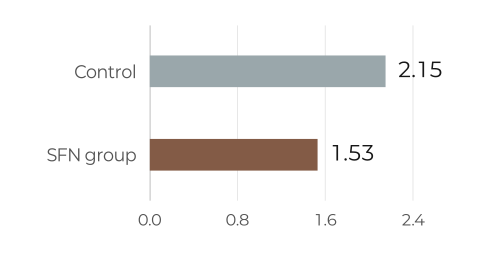
Lower values indicate less cell division · significant difference observed
SFN 0.026 mg/kg · intraperitoneal injection
Read Pogorzelska · 2024 →View values and units
| Group | Value | Standard deviation |
|---|---|---|
| Control | 2.15 | 0.13 |
| SFN group | 1.53 | 0.57 |
Cancer related mechanisms · research results at a glance
7 studies
Early human trials in cancer patients · PSA, tissue markers, and survival
| Study and participants | Intake and observation | Findings and context |
|---|---|---|
| Wang · 2022 United States · 30 postmenopausal patients with breast cancer |
Sprout extract ITC 200μmol/day 2 weeks · tumor tissue comparison | Response in breast tissue before surgeryFinding: The cell proliferation marker Ki-67 tended to be lower in the intake group, but within group and between group differences were not significant. Context: Extract and placebo were compared for two weeks before surgery. |
| Lozanovski · 2020 Germany · 40 patients with advanced pancreatic cancer |
Sprout powder capsules · up to one year 15 capsules daily: sulforaphane 90mg + glucoraphanin 180mg | Intake and survival follow up in pancreatic cancer patientsFinding: Observed 180 day mortality was 25% in the intake group and 43% in the comparison group. Context: The between group difference was not significant (p = 0.291). Changes to assignment, high dropout, digestive discomfort, and nausea were also reported. |
| Alumkal · 2015 United States · 20 patients with recurrent prostate cancer |
Sulforaphane 200μmol/day sprout extract · up to 20 weeks | PSA follow up in recurrent prostate cancerFinding: A PSA decrease of at least 50% occurred in one of 20 participants, missing the primary goal. The exploratory measure of PSA doubling time lengthened from 6.1 to 9.6 months. Context: A study comparing intake and study periods without a control group. |
Related human studies · tissue responses and metabolite excretion
| Study and participants | Intake and observation | Findings and context |
|---|---|---|
| Traka · 2019 United Kingdom · prostate cancer under active surveillance |
Broccoli soup 300mL/week three GLR-content groups · 12 months | Finding: The high GLR soup group had less change in cancer related gene expression in prostate tissue. Context: A small trial of gene responses in prostate tissue. |
| Egner · 2014 China · 291 adults exposed to air pollution |
GLR 600μmol/day + SFN 40μmol/day sprout beverage · 12-week placebo comparison | Finding: Urinary excretion of benzene and acrolein metabolites increased 61% and 23% respectively versus placebo. Context: A human trial measuring metabolism and excretion of air pollutants; the endpoint was an excretion marker. |
Animal research and literature review · mechanistic evidence
| Study and participants | Intake and observation | Findings and context |
|---|---|---|
| Pogorzelska · 2024 Mouse breast cancer model · eight per group |
Sulforaphane 0.026mg/kg intraperitoneal injection on days 10, 16, and 23 | Finding: The mitotic index of mouse tumors was 2.15 in the comparison group and 1.53 in the treatment group. Context: An intraperitoneal injection trial. The difference in lung metastasis nodules, 34 versus 23, was not significant. |
| Ali · 2023 Review of mechanisms in existing studies |
Review of cancer-related molecular pathways gene regulation, apoptosis, and more | Finding: A review of cancer related molecular and gene regulatory pathways involving sulforaphane. Context: A literature review synthesizing cancer related mechanisms. |
Sources
- Wang et al. Mol Nutr Food Res. 2022;66:e2101094.DOI 10.1002/mnfr.202101094
- Lozanovski et al. Invest New Drugs. 2020;38:776-784.DOI 10.1007/s10637-019-00826-z
- Alumkal et al. Invest New Drugs. 2015;33:480-489.DOI 10.1007/s10637-014-0189-z
- Traka et al. Am J Clin Nutr. 2019;109:1133-1144.DOI 10.1093/ajcn/nqz012
- Egner et al. Cancer Prev Res. 2014;7:813-823.DOI 10.1158/1940-6207.CAPR-14-0103
- Pogorzelska et al. Sci Rep. 2024;14:16016.DOI 10.1038/s41598-024-65455-w
- Ali et al. Front Oncol. 2023;13:1168321.DOI 10.3389/fonc.2023.1168321