Sleep and mood
Sleep & Mood
A pilot study of mood and sleep changes over 12 weeks
In a 12 week trial of 144 older adults, negative mood scores improved versus placebo. An 18 person sleep pilot study did not find a significant between group difference.
- 144 participants
- Controlled mood assessment trial
- 12 weeks
- Trial duration
- 30 mg/day
- GLR dose

Negative Mood · Mean Change
Mean change in TMD score · points
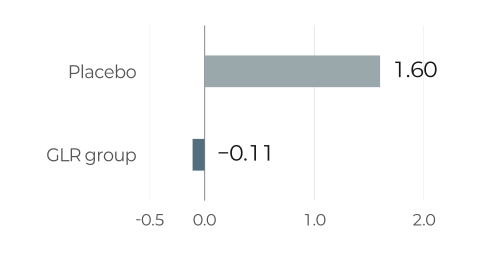
Lower scores indicate less negative mood · adjusted p = 0.03
144 participants · 12 weeks · measured separately from sleep
Read Nouchi · 2022 →View values and units
| Group | Value | Standard deviation |
|---|---|---|
| Placebo | 1.60 | 9.40 |
| GLR group | −0.11 | 6.95 |
Sleep and mood · research results at a glance
6 studies
Mood · 12 week controlled human trial
| Study and participants | Intake and observation | Findings and context |
|---|---|---|
| Nouchi · 2022 Japan · 144 adults aged 60–80 |
Glucoraphanin 30 mg/day; 12 weeks; two group comparison; mood questionnaire (TMD) | Mood score change: comparison +1.60 / intake −0.11Finding: The intake group had a better change in negative mood than the comparison group (adjusted p = 0.03); lower scores mean more favorable change. Context: A 12 week between group comparison of mood questionnaire scores. |
Sleep · four week pilot study
| Study and participants | Intake and observation | Findings and context |
|---|---|---|
| Kikuchi · 2021 Japan · 18 healthy adults with sleep complaints |
Glucoraphanin 30mg/day 4 weeks · two-group comparison sleep questionnaire and melatonin measured | Sleep satisfaction and melatonin assessmentFinding: Sleep satisfaction and the melatonin measure rose from baseline in the intake group, but the difference from placebo was not significant. Context: A four week pilot study of 18 adults with sleep discomfort. |
Related literature · sleep and antioxidant mechanisms
| Study and participants | Intake and observation | Findings and context |
|---|---|---|
| Davinelli · 2024 Review of existing studies |
Sleep, oxidative stress, and NRF2 review of existing literature | Finding: A review of the links between sleep and oxidative stress and the role of the antioxidant regulator NRF2. Context: A literature review explaining connections between sleep and cellular defense. |
Animal research · intermittent hypoxia and circadian rhythm
| Study and participants | Intake and observation | Findings and context |
|---|---|---|
| He · 2024 Mouse · circadian disruption model |
Sulforaphane administration clock proteins, liver, and gut assessed | Finding: Changes were observed in mouse circadian clock proteins, liver fat accumulation, and gut microbiome. Context: Results from a mouse model using a high fat diet and disrupted circadian rhythm. |
| Li · 2022 Mouse · intermittent hypoxia model |
Sulforaphane 0.5mg/kg/day intraperitoneal injection · 4 weeks | Finding: Memory test errors and oxidative brain damage decreased in mice, alongside changes related to NRF2 and autophagy. Context: A mechanistic study using intraperitoneal injection in a mouse hypoxia model. |
Human ingredient conversion study · enzymes from mustard powder
| Study and participants | Intake and observation | Findings and context |
|---|---|---|
| Okunade · 2018 12 healthy adults |
Cooked broccoli 200g with or without 1g mustard powder 24-hour urine collection after intake | Finding: Urinary excretion of sulforaphane metabolites increased when mustard powder was added. Context: A human ingredient conversion study using enzymes in mustard powder. |
Sources
- Nouchi et al. Front Aging Neurosci. 2022;14:929628.DOI 10.3389/fnagi.2022.929628
- Kikuchi et al. J Funct Foods. 2021;84:104574.DOI 10.1016/j.jff.2021.104574
- Davinelli et al. Cell Mol Neurobiol. 2024.DOI 10.1007/s10571-024-01487-0
- He et al. Mol Nutr Food Res. 2024;68:e2400535.DOI 10.1002/mnfr.202400535
- Li et al. Front Cell Neurosci. 2022;16:827527.DOI 10.3389/fncel.2022.827527
- Okunade et al. Mol Nutr Food Res. 2018;62:1700980.DOI 10.1002/mnfr.201700980