Cognitive health
Cognitive Health
Information processing and working memory in older adults, observed in 12 week controlled trials
Two 12 week trials in healthy older adults found improved processing speed with glucoraphanin intake. The 2021 trial also observed improved working memory.
- 144 participants
- 2022 processing speed trial
- 12 weeks
- Trial duration
- 30 mg/day
- GLR dose

Processing Speed · Mean Change
Mean change in SS test score · points
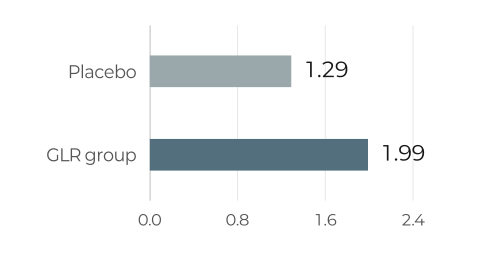
Higher scores indicate better processing speed · adjusted p = 0.03
144 participants · 12 weeks · GLR 30 mg/day
Read Nouchi · 2022 →View values and units
| Group | Value | Standard deviation |
|---|---|---|
| Placebo | 1.29 | 4.76 |
| GLR group | 1.99 | 3.83 |
Cognitive health · research results at a glance
8 studies
Cognitive function in older adults · 12 week controlled trial
| Study and participants | Intake and observation | Findings and context |
|---|---|---|
| Nouchi · 2022 Japan · 144 adults aged 60–80 |
Glucoraphanin 30mg/day 12 weeks · two-group comparison | Processing speed change: comparison +1.29 / intake +1.99 pointsFinding: The mean increase in Symbol Search score over 12 weeks; mood measures also improved. Context: These were processing speed and mood results; working memory did not differ significantly between groups. |
| Nouchi · 2021 Japan · 144 healthy older adults |
Glucoraphanin 30mg/day 12 weeks · game training also compared | Improvement on processing speed and working memory testsFinding: The intake group improved significantly on processing speed and working memory tests versus the comparison group. Context: The effects of the ingredient and training were assessed separately. Additional benefit from combining them was not significant. |
Long term follow up · 42 month pilot trial
| Study and participants | Intake and observation | Findings and context |
|---|---|---|
| Shimizu · 2026 Japan · participants at risk of cognitive decline |
Glucoraphanin 30mg/day mustard powder 120mg/day 3 years 6 months · two-group comparison | 42 month long term pilot trialFinding: Memory score improvement over the full follow up was greater in the glucoraphanin group. The 42 month change and rates of cognitive status transition or recovery did not differ significantly between groups. Context: Results from 25 participants in the full analysis and 19 completers. |
Another clinical population · participants with schizophrenia
| Study and participants | Intake and observation | Findings and context |
|---|---|---|
| Hei · 2022 China · 172 people with early schizophrenia |
Glucoraphanin + conversion enzyme 4 or 6 research tablets/day 22 weeks · added to usual treatment | Finding: Some improvements were observed in spatial working memory and verbal learning. Context: A result observed on some individual tests; the between group difference in the composite score was not significant. |
| Shiina · 2015 Japan · 10 patients with schizophrenia |
Glucoraphanin 30mg/day 8 weeks · added to usual treatment | Finding: Improvement was observed on a card memory test. Context: An uncontrolled add on trial to usual treatment. Changes in other cognitive tests were not significant. |
Dietary observation · vegetable intake and dementia
| Study and participants | Intake and observation | Findings and context |
|---|---|---|
| Ghasemifard · 2024 Australia · 1,206 women aged 70 and older |
Usual vegetable type and intake survey 14.5-year follow-up | Finding: Intake of yellow, orange, and red vegetables, alliums, and green leafy vegetables was associated with lower dementia risk. Context: An observational study following vegetable group intake and dementia risk. |
| Kishida · 2024 Japan · 42,643 people aged 50–79 |
Usual fruit and vegetable intake survey dementia ascertainment: 2006–2016 | Finding: In the highest fruit and vegetable intake group, dementia risk was observed to be about 13% lower in men and 15% lower in women than in the lowest intake group. Context: An association from an observational study following usual diet. |
Mechanism · human antioxidants
| Study and participants | Intake and observation | Findings and context |
|---|---|---|
| Sedlak · 2018 United States · nine healthy adults |
Sulforaphane 100μmol/day 7 days · blood tests and brain imaging | Finding: Higher blood glutathione (GSH) was associated with changes in blood and the brain thalamus. Context: Antioxidant markers in blood and brain were measured. |
Sources
- Nouchi et al. Front Aging Neurosci. 2022;14:929628.DOI 10.3389/fnagi.2022.929628
- Nouchi et al. Nutrients. 2021;13:352.DOI 10.3390/nu13020352
- Shimizu et al. Front Nutr. 2026;13:1740494.DOI 10.3389/fnut.2026.1740494
- Hei et al. Schizophr Bull Open. 2022;3:sgac024.DOI 10.1093/schizbullopen/sgac024
- Shiina et al. Clin Psychopharmacol Neurosci. 2015;13:62-67.DOI 10.9758/cpn.2015.13.1.62
- Ghasemifard et al. Food Funct. 2024;15:10885-10895.DOI 10.1039/d4fo03239j
- Kishida et al. J Nutr. 2024;154:1842-1852.DOI 10.1016/j.tjnut.2024.04.008
- Sedlak et al. Mol Neuropsychiatry. 2018;3:214-222.DOI 10.1159/000487639