NOUCHI · 2021 / NUTRIENTS
Glucoraphanin Intake and Changes in Processing Speed and Working Memory
A 12-week randomized controlled trial in 144 healthy older adults examined glucoraphanin intake and brain training separately.
Paper details · DOI 10.3390/nu13020352 ↓
- Participants
- 144
Healthy older adults in Japan
- Duration
- 12 weeks
Cognitive tests at baseline and week 12
- Study ingredient
- 30 mg/day
Glucoraphanin (GLR)
- Comparison
- 4 groups
Randomized · double-blind
Key findings
Processing speed improved
Change in Symbol Search (SS) score was greater with glucoraphanin than with placebo.
Working memory improved
Glucoraphanin also had a significant main effect on Digit Span Backward (DS-B), a working-memory test.
No additional combined benefit established
Combining brain training with glucoraphanin did not produce a significant benefit beyond their separate effects.
The main effects of glucoraphanin intake on SS and DS-B both had false-discovery-rate-adjusted p < 0.05. Original results
Study design
The 144 participants were assigned in groups of 36. Each group played a brain-training game or Tetris for about 15 minutes daily and took a capsule with 30 mg glucoraphanin or placebo for 12 weeks.
Brain training + GLR
Brain Age + glucoraphanin
Brain training + placebo
Brain Age + placebo capsule
Tetris + GLR
Tetris + glucoraphanin
Tetris + placebo
Tetris + placebo capsule
GLR is a precursor of sulforaphane; the 30 mg daily dose in this trial refers to glucoraphanin. Mean age was 67.7 years. The analysis included all 144 assigned participants, with missing values imputed for two dropouts. Original methods
Symbol Search score change after 12 weeks
Mean change in the processing-speed test by study group.
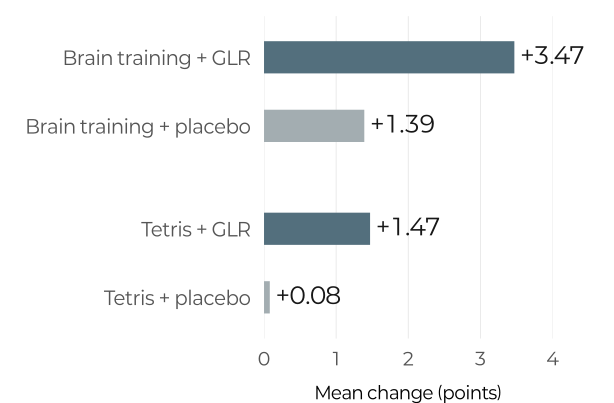
Bars show group means. The paper analyzed brain-training and intake effects after adjustment for baseline score, age, and other variables.
Both test results · mean change and standard deviation
| Group | Symbol Search (SS) | Working memory (DS-B) |
|---|---|---|
| Brain training + GLR | 3.47 ± 2.95 | 0.92 ± 1.56 |
| Brain training + placebo | 1.39 ± 3.50 | 0.36 ± 1.50 |
| Tetris + GLR | 1.47 ± 3.80 | 0.81 ± 1.55 |
| Tetris + placebo | 0.08 ± 4.12 | −0.11 ± 1.75 |
Standard deviation describes the spread of participant changes around each mean. Original Table 3
Study context
This trial used glucoraphanin capsules to assess processing speed and working memory in healthy older adults. Intake and brain training were analyzed as separate factors.
Participants were assessed at baseline and after 12 weeks.
ORIGINAL PAPER
Paper details
Brain Training and Sulforaphane Intake Interventions Separately Improve Cognitive Performance in Healthy Older Adults, Whereas a Combination of These Interventions Does Not Have More Beneficial Effects: Evidence from a Randomized Controlled Trial
Rui Nouchi, Qingqiang Hu, Toshiki Saito, Natasha Yuriko dos Santos Kawata, Haruka Nouchi, Ryuta Kawashima
Nutrients. 2021;13(2):352. · Published January 25, 2021
DOI: 10.3390/nu13020352 · PMID: 33503851
Funding and interests
The study was supported by Kagome and the Japan Society for the Promotion of Science. Authors included Kagome employees and grant recipients, and a researcher who developed Nintendo's Brain Age. The paper states that the company was not involved in study design, analysis, or publication decisions.
The original paper is available under CC BY 4.0. English summary and chart: Wellbeing200 Co., Ltd.