Autism spectrum
Autism Spectrum
Hyperactivity and social response changes observed in controlled human trials
Some human trials and meta analyses reported improvement in hyperactivity and social response measures. Results varied with participant age, rater, and outcome measure.
Study materials: sulforaphane extract or tablets containing glucoraphanin and myrosinase.
View behavioral domains assessed in the meta analysis- 5 studies
- Key controlled human trials
- 17 studies
- All included papers
- 2026
- Most recent included paper

Behavior and Social Responsiveness · 18-Week Placebo Comparison
Mean score reduction from baseline (points) · compare within each scale

ABC fell 19.44 points and SRS 18.40 points more than placebo
Mean change at 18 weeks in males aged 13–27. Negative changes in the source are shown as score reductions; between-group differences subtract the two mean reductions. ABC p < 0.001 · SRS p = 0.017.
Read Singh · 2014 →View values and units
| Group | Value |
|---|---|
| ABC behavior SFN | 21.44 |
| ABC behavior placebo | 2.00 |
| SRS social response SFN | 20.40 |
| SRS social response placebo | 2.00 |
Pooled Results from 6 Controlled Trials
Standardized mean difference (SMD) · values below zero favor SFN
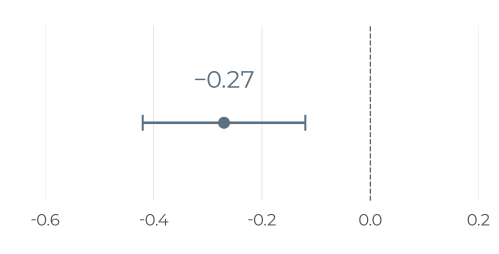
Pooled effect −0.27 · 95% confidence interval −0.42 to −0.12
Point: pooled estimate; line: 95% confidence interval. Scale differences are expressed in standard deviation units. Results varied by assessment tool, rater, and duration.
Read Wang · 2025 →View values and units
| Group | Estimate | 95% confidence interval |
|---|---|---|
| Difference versus placebo | -0.27 | -0.42 ~ -0.12 |
Autism spectrum · research results at a glance
17 studies
Five controlled human trials · age, duration, and assessment conditions
| Study and participants | Intake and observation | Findings and context |
|---|---|---|
| Magner · 2023 Forty children with ASD randomized · ages 3–7 |
SFN 50 µmol/day · 36 weeks Compared with a spinach powder placebo | 36 week assessment of children aged 3–7 yearsFinding: No significant improvement was found on SRS-2, ABC, or ADOS-2. Context: Twenty eight completers aged 3–7 years. Forty were randomized, with dropouts. |
| Ou · 2024 108 children with ASD in China |
Tablets containing GLR and active myrosinase Weight-based dose · 12 weeks | Results by rater in the 108 participant multicenter trialFinding: Improvement was observed in clinician ratings, while between group differences in caregiver ratings were not significant. Context: A multicenter trial of 108 participants. Published online in 2022 and assigned to a journal volume and issue in 2024. |
| Zimmerman · 2021 Fifty-seven children with ASD randomized · ages 3–12 |
Tablets containing GLR and active myrosinase 15-week controlled trial + 15-week open-label intake + six-week discontinuation | Clinician and caregiver assessments at 15 weeksFinding: At 15 weeks, the ABC total score decreased more than with placebo (d = −0.96). The primary clinical measure OACIS and social response measure SRS-2 were not significant. Context: A 15 week placebo comparison followed by 15 weeks of open intake and six weeks off treatment. |
| Momtazmanesh · 2020 Sixty children with ASD · ages 4–12 |
SFN 50–100 µmol/day or placebo With risperidone · 10 weeks | Irritability decreased 10.27 versus 7.10 pointsFinding: With risperidone in both groups, irritability fell 3.17 points more and hyperactivity/noncompliance 3.47 points more. Other behavioral domains did not differ significantly. Context: Both groups used risperidone in this add on trial. |
| Singh · 2014 44 males · ages 13–27 |
Broccoli sprout-derived SFN 50–150 µmol/day 18 weeks of intake · four-week follow-up after discontinuation | Lower ABC and SRS scores than placebo at 18 weeksFinding: At 18 weeks, mean reductions were 21.44 points versus 2.00 on ABC and 20.40 versus 2.00 on SRS, in the sulforaphane and placebo groups respectively. Context: This extract trial involved males aged 13–27 years. The ABC 34% and SRS 17% figures are reductions in scale scores from baseline within the intake group. |
Four open label, follow up, and biomarker studies · links to clinical trials
| Study and participants | Intake and observation | Findings and context |
|---|---|---|
| Yang · 2024 Six boys with ASD aged 4–7 from an earlier trial |
Human: GLR and myrosinase tablets for 12 weeks Mouse: intraperitoneal SFN injection for 28 days | Follow up analysis of six participants; associations between some bacterial groups and behaviorFinding: Changes in nonverbal communication were observed, but overall microbiome diversity did not change significantly. The study combined a follow up human analysis with a rat injection experiment. Context: A follow up analysis of part of the Ou trial and a mouse injection experiment. |
| Liu · 2020 Ten boys with ASD · approximately 6–12 years |
GLR and myrosinase tablets · 14 days Target SFN dose in the study: approximately 2.2 µmol/kg/day | Exploration of cell responses and individual metabolic differencesFinding: In a pilot study of 10 people, urinary metabolite recovery ranged from 8.2% to 68.4%. The study explored biomarkers for a follow up trial. Context: A 14 day biomarker pilot study with 10 participants. |
| Bent · 2018 Twenty-one participants with ASD enrolled · 15 analyzed |
Tablets containing GLR and myrosinase Weight-based dose · 12 weeks | SRS −9.7 points · uncontrolled before and after comparisonFinding: After 12 weeks, social response and communication and motivation subscales changed. The total ABC score was not significant; researchers also explored associations with urinary metabolites. Context: An open label trial without a control group. Associations with 77 metabolites were exploratory. |
| Lynch · 2017 Of 26 SFN recipients in the Singh trial, |
Experience using commercial supplements after the trial Follow-up through summer 2016 | Everyday experiences and long term use reported by 16 familiesFinding: A follow up case report on communication, behavior, and daily participation. Families of initial responders were overrepresented. Context: Follow up data from some Singh 2014 participants. |
Four cell and animal mechanism studies
| Study and participants | Intake and observation | Findings and context |
|---|---|---|
| Sikora · 2026 95 male and female BTBR and C57BL/6 mice total |
SFN 0.1% feed or standard feed Exposure from pregnancy to postnatal day 60 | Behavior changes after long term diet · differences by sexFinding: In male and female BTBR mice, repetitive behavior, social interaction, and antioxidant and inflammation markers changed. Some neurochemical responses were observed in males. Context: An animal dietary experiment from pregnancy through 60 days after birth. |
| Vallese · 2025 Skin fibroblast cultures from five people with ASD and four comparators |
SFN 10 µM · timed cell treatment Separate hemin treatment experiment | NRF2 response in patient derived skin cellsFinding: The study described cell conditions that did not respond sufficiently to sulforaphane stimulation. HO1 and mitochondrial recovery came from a separate hemin experiment. Context: Skin cells were treated separately with sulforaphane and hemin for comparison. |
| Bessetti · 2025 Human iPSC-derived neurodevelopmental model |
VPA and SFN treatment in cultured cells NRF2, gene expression, and neural activity analyses | Protection of synapses and activity in cultured neural networksFinding: In a VPA exposure model, researchers examined NRF2 and antioxidant gene responses and protection of synapse formation. Context: Cultured experiments with human derived neurodevelopmental models and mouse neurons. |
| Nadeem · 2019 BTBR mice and C57 comparator strain |
SFN-treated versus untreated groups Behavioral, immune, and oxidative stress analyses | Changes in mouse social behavior and immune responseFinding: In BTBR mice, increased social interaction and reduced repetitive behavior were observed alongside changes related to Th17 and oxidative stress. Context: A mechanistic study of behavior, immunity, and antioxidant responses in BTBR mice. |
Four literature syntheses · meta analyses and mechanistic review
| Study and participants | Intake and observation | Findings and context |
|---|---|---|
| Zhang · 2026 Earlier cell, animal, and clinical literature |
2026 mechanistic review Seven candidate signaling pathways | Research map connecting seven signaling pathwaysFinding: A review of antioxidant, inflammatory, heat shock, autophagy, and other pathways from existing mechanistic literature. Context: A review of seven candidate pathways from cell, animal, and clinical literature. |
| Long · 2025 Six controlled trials · 333 participants total |
Literature search through February 21, 2025 Meta-analysis, network analysis, docking, and other methods | SRS improved at some time points · high inconsistency across studiesFinding: SRS differed at weeks 4–5 and 8–10, but studies were highly inconsistent and later time points were not significant. The computational model is a separate mechanistic hypothesis. Context: Meta analysis of existing trials and target predictions from a computational model. |
| Wang · 2025 Pooled six randomized controlled trials |
Eight databases searched through September 2024 Analyses by scale, rater, and duration | Pooled difference in hyperactivity and social interactionFinding: Overall SMD −0.27; hyperactivity −0.58; social interaction −0.43. Irritability, anxiety, and sensory sensitivity were not significant. Context: A standardized effect size across different scales, pooling six existing trials. |
| Guo · 2025 Six controlled trials · 333 participants total |
Literature search through July 2024 Combined ABC and SRS outcomes | Pooled signal of improvement in irritability and hyperactivityFinding: Existing trials focused on ABC and SRS; improvements in irritability and hyperactivity were reported. Context: Five published studies and one set of registered results were pooled. |
Sources
- Magner M, Thorová K, Župová V, Houška M, Švandová I, Novotná P, Tříska J, Vrchotová N, Soural I, Jílek L. Sulforaphane Treatment in Children with Autism: A Prospective Randomized Double-Blind Study. Nutrients. 2023.DOI 10.3390/nu15030718
- Ou J, Smith RC, Tobe RH, Lin J, Arriaza J, Fahey JW, Liu R, Zeng Y, Liu Y, Huang L, Shen Y, Li Y, Cheng D, Cornblatt B, Davis JM, Zhao J, Wu R, Jin H. Efficacy of Sulforaphane in Treatment of Children with Autism Spectrum Disorder: A Randomized Double-Blind Placebo-Controlled Multi-center Trial. Journal of autism and developmental disorders. 2024.DOI 10.1007/s10803-022-05784-9
- Zimmerman AW, Singh K, Connors SL, Liu H, Panjwani AA, Lee LC, Diggins E, Foley A, Melnyk S, Singh IN, James SJ, Frye RE, Fahey JW. Randomized controlled trial of sulforaphane and metabolite discovery in children with Autism Spectrum Disorder. Molecular autism. 2021.DOI 10.1186/s13229-021-00447-5
- Momtazmanesh S, Amirimoghaddam-Yazdi Z, Moghaddam HS, Mohammadi MR, Akhondzadeh S. Sulforaphane as an adjunctive treatment for irritability in children with autism spectrum disorder: A randomized, double-blind, placebo-controlled clinical trial. Psychiatry and clinical neurosciences. 2020.DOI 10.1111/pcn.13016
- Singh K, Connors SL, Macklin EA, Smith KD, Fahey JW, Talalay P, Zimmerman AW. Sulforaphane treatment of autism spectrum disorder (ASD). Proceedings of the National Academy of Sciences of the United States of America. 2014.DOI 10.1073/pnas.1416940111
- Yang J, He L, Dai S, Zheng H, Cui X, Ou J, Zhang X. Therapeutic efficacy of sulforaphane in autism spectrum disorders and its association with gut microbiota: animal model and human longitudinal studies. Frontiers in nutrition. 2024.DOI 10.3389/fnut.2023.1294057
- Liu H, Zimmerman AW, Singh K, Connors SL, Diggins E, Stephenson KK, Dinkova-Kostova AT, Fahey JW. Biomarker Exploration in Human Peripheral Blood Mononuclear Cells for Monitoring Sulforaphane Treatment Responses in Autism Spectrum Disorder. Scientific reports. 2020.DOI 10.1038/s41598-020-62714-4
- Bent S, Lawton B, Warren T, Widjaja F, Dang K, Fahey JW, Cornblatt B, Kinchen JM, Delucchi K, Hendren RL. Identification of urinary metabolites that correlate with clinical improvements in children with autism treated with sulforaphane from broccoli. Molecular autism. 2018.DOI 10.1186/s13229-018-0218-4
- Lynch R, Diggins EL, Connors SL, Zimmerman AW, Singh K, Liu H, Talalay P, Fahey JW. Sulforaphane from Broccoli Reduces Symptoms of Autism: A Follow-up Case Series from a Randomized Double-blind Study. Global advances in health and medicine. 2017.DOI 10.1177/2164957x17735826
- Sikora V, Bove M, Agosti LP, Palmieri RP, Zafar M, Tucci P, Morgese MG, Schiavone S, Trabace L. Effects of lifelong sulforaphane intake on behavioural, neurochemical and biomolecular dysfunctions in the BTBR T+ Itpr3tf/J mouse model of autism spectrum disorders. British Journal of Pharmacology. 2026.DOI 10.1111/bph.70693
- Vallese A, Melija S, Hayek J, Pecorelli A, Valacchi G. Deregulated Nrf2-Keap1-BACH1 axis in autism spectrum disorder. Redox biology. 2025.DOI 10.1016/j.redox.2025.103837
- Bessetti RN, Cobb M, Lilley RM, Johnson NZ, Perez DA, Koonce VM, McCoy K, Litwa KA. Sulforaphane protects developing neural networks from VPA-induced synaptic alterations. Molecular psychiatry. 2025.DOI 10.1038/s41380-025-02967-5
- Nadeem A, Ahmad SF, Al-Harbi NO, Attia SM, Bakheet SA, Ibrahim KE, Alqahtani F, Alqinyah M. Nrf2 activator, sulforaphane ameliorates autism-like symptoms through suppression of Th17 related signaling and rectification of oxidant-antioxidant imbalance in periphery and brain of BTBR T+tf/J mice. Behavioural brain research. 2019.DOI 10.1016/j.bbr.2019.02.031
- Zhang X, He Q, Zhu YY, Lorimer GH, Bayram H, Ghiladi RA, Wang J. Emerging Promise of Sulforaphane in Autism: A Comprehensive Review of Its Therapeutic Potential and Mechanisms. ACS chemical neuroscience. 2026.DOI 10.1021/acschemneuro.6c00282
- Long J, Liao X, Tang Z, Han K, Chen J, Wang X, Liu J, Zhang Y, Zhang H. Investigating the clinical efficacy, safety and molecular mechanism of sulforaphane in autism spectrum disorder: an integrated study combining meta-analysis, network pharmacology, and computational biology. BMC pharmacology & toxicology. 2025.DOI 10.1186/s40360-025-01052-5
- Wang R, Ren Z, Li Y. The effect of sulforaphane on autism spectrum disorder: systematic review and meta-analysis. EXCLI journal. 2025.DOI 10.17179/excli2025-8239
- Guo J, Wang Y, He W, Lou M, Peng Y, Shi H, Lian A. Effects of sulforaphane on ABC and SRS scales in patients with autism spectrum disorder: a meta-analysis. Brain & development. 2025.DOI 10.1016/j.braindev.2025.104321
Registered trials beyond the cited papers
Registered results for NCT02909959 · Registered results from a randomized trial of 48 participants. Several meta analyses included them alongside five published studies.