Wang · 2025 · EXCLI journal
Meta-analysis by assessment domain
Did pooled results agree for the total score and specific behavioral domains?
Literature · systematic review and meta-analysis

Key findings
Small difference in the total score
The reported SMD for the overall outcome was −0.27 (95% CI −0.42 to −0.12).
Changes in hyperactivity and social interaction
Significant differences were found for hyperactivity (SMD −0.58) and social interaction (SMD −0.43). Irritability, anxiety, and sensory sensitivity were not significant.
Effect of assessment conditions
The authors explained that results may vary by scale, rater, and duration, and called for further research.
Pooled Results from 6 Controlled Trials
Standardized mean difference (SMD) · values below zero favor SFN
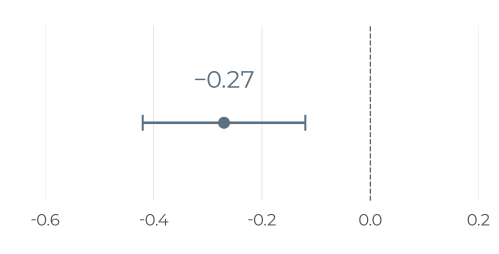
Pooled effect −0.27 · 95% confidence interval −0.42 to −0.12
Point: pooled estimate; line: 95% confidence interval. Scale differences are expressed in standard deviation units. Results varied by assessment tool, rater, and duration.
Read the original paper and sources ↓View values and units
| Group | Estimate | 95% confidence interval |
|---|---|---|
| Difference versus placebo | -0.27 | -0.42 ~ -0.12 |
Detailed results
Overall and behavior-domain results
Eight databases were searched through September 2024, and six randomized controlled trials were pooled. The analysis included five published trials and results from registered trial NCT02909959. Different scales were converted to standardized mean differences (SMD) for comparison.
| Assessment domain | SMD | 95% confidence interval |
|---|---|---|
| Overall measures | −0.27 | −0.42~−0.12 |
| Problem behavior | −0.43 | −0.66~−0.19 |
| Hyperactivity | −0.58 | −1.03~−0.13 |
| Social interaction | −0.43 | −0.59~−0.27 |
| Social communication | −0.24 | −0.35~−0.12 |
Pooled estimates reported in the paper. The scales and data used differ by domain.
Differences in social function and specific behavioral domains
Social interaction and communication differed, but social awareness, cognition, motivation, and overall social functioning did not differ significantly. Irritability, anxiety, and sensory sensitivity were also not significant. A small difference was reported in restricted and repetitive behavior, with the confidence interval boundary very close to zero.
An SMD of −0.27 expresses the scale difference in standard-deviation units. The confidence interval shows the uncertainty around the estimate.
Assessment method and duration affect conclusions.
The authors noted that results can vary by assessment tool, rater, and duration. A difference was also observed in a subgroup of trials lasting at least ten weeks. Most trials were small and short; persistence after discontinuation and long-term safety remain topics for follow-up study.
The pooled analysis includes individual controlled trials covered in this report.
Study design
Six trials were pooled to analyze effect sizes for overall and subscale outcomes and adverse events. Differences by assessment tool, rater, and duration were also examined.
- Participants
- Pooled six randomized controlled trials
Includes registered trial NCT02909959 - Intake and observation
- Eight databases searched through September 2024
Analyses by scale, rater, and duration - Measures
- Standardized mean difference (SMD), 95% confidence interval, and adverse events
Study context
SMD expresses differences between scales as an effect size in standard-deviation units. The six earlier trials analyzed overlap with Guo and Long.
Original paper and sources
The effect of sulforaphane on autism spectrum disorder: systematic review and meta-analysis.
- Journal
- EXCLI journal · 2025 · 24: 542-557
- First published
- 2025-04-07