Magner · 2023 · Nutrients
A 36-week controlled trial in children aged 3–7 years
Did long-term behavioral and social responsiveness assessments differ in children aged 3–7 years?
Human · randomized double-blind controlled trial

Key findings
Behavioral and social responsiveness assessments over 36 weeks
A trial that assigned 40 children aged 3–7 years and analyzed 28 found no significant clinical improvements on SRS-2, ABC, or ADOS-2.
Social Responsiveness · Baseline and Week 36
Mean SRS-2 raw score · lower indicates a better rating
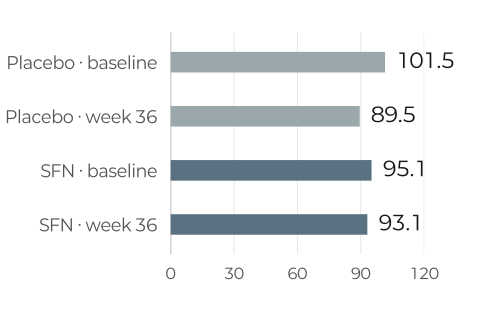
Week 36 between-group difference was not significant · p = 0.7435
28 completers aged 3–7. Baseline scores differed between groups. Time-point means are from Table 2.
Read the original paper and sources ↓View values and units
| Group | Value |
|---|---|
| Placebo · baseline | 101.5 |
| Placebo · week 36 | 89.5 |
| SFN · baseline | 95.1 |
| SFN · week 36 | 93.1 |
Detailed results
A trial with longer follow-up in younger children
Forty children aged 3–7 years were assigned to 50 µmol/day of SFN or a spinach powder placebo for 36 weeks. Five could not tolerate the preparation, and seven lacked follow-up data; the analysis compared the 28 completers.
Caregiver-completed ABC and SRS-2 and expert-administered ADOS-2 were used together. A feature of the study was testing whether caregiver-perceived changes and standardized assessments pointed in the same direction.
| Time point | 15 participants in the sulforaphane group | 13 participants in the placebo group |
|---|---|---|
| Baseline | 95.1 | 101.5 |
| 18 weeks | 93.1 | 91.8 |
| 36 weeks | 93.1 | 89.5 |
Table 2 of the paper. The week-36 between-group score comparison had p=0.7435 and was not statistically significant.
No significant between-group difference at the 36-week assessment
Some mean scores fell in both groups, but there were no significant between-group differences on SRS-2, ABC, or ADOS-2. Parents' overall impressions of improvement and expert ratings did not agree.
Sample and formulation characteristics
Participants were 3–7 years old, and 28 completed the trial. The formulation also differed from other trials, so the authors discussed age, formulation, and individual response differences as follow-up research topics.
Follow-up commentary and the authors' response discussed diet, combined nutritional supplements, individual metabolic differences, and applying animal results to humans.
Study design
Assessments at baseline, week 18, and week 36 were compared for 28 completers. The SFN group used a standardized preparation; the comparator group used spinach powder placebo.
- Participants
- Forty children with ASD randomized · ages 3–7
28 completers: 15 SFN / 13 placebo - Intake and observation
- SFN 50 µmol/day · 36 weeks
Compared with a spinach powder placebo - Measures
- SRS-2 social responsiveness, ABC behavior ratings, ADOS-2 observational assessment
Study context
Fifteen in the sulforaphane group and 13 in the placebo group completed 36 weeks. Baseline scores differed, and assessments at baseline, 18 weeks, and 36 weeks were compared.
Original paper and sources
Sulforaphane Treatment in Children with Autism: A Prospective Randomized Double-Blind Study.
- Journal
- Nutrients · 2023 · 15(3): 718
- First published
- 2023-01-31
Curtis 2024 commentary · A commentary on dietary intake and combined nutritional approaches.
Magner 2024 author response · A response discussing the application of animal and in vitro results to humans, individual variation, and interpretation of combination supplements.