Bent · 2018 · Molecular autism
Social responsiveness and urinary metabolites in an open-label intake study
Did behavioral-rating changes occur alongside changes in urinary metabolites?
Human · uncontrolled open-label study

Key findings
Behavioral and social responsiveness assessments over 12 weeks
In an open-label study without a control group, SRS fell by 9.7 points (95% CI −18.7 to −0.8). ABC fell by 7.1 points, but the change was not significant (−17.4 to 3.2).
Exploration of urinary metabolites
Seventy-seven urinary metabolites associated with rating changes were identified to explore oxidative stress and metabolic pathways.
12-Week Score Changes and Confidence Intervals
Mean score change · 95% confidence interval · no placebo control
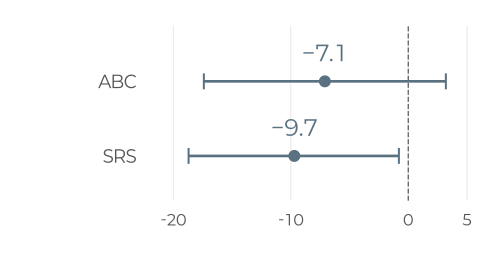
ABC interval includes zero; SRS interval does not
Before-and-after scale-score changes in 15 participants over 12 weeks.
Read the original paper and sources ↓View values and units
| Group | Estimate | 95% confidence interval |
|---|---|---|
| ABC | -7.1 | -17.4 ~ 3.2 |
| SRS | -9.7 | -18.7 ~ -0.8 |
Detailed results
Social responsiveness improved after 12 weeks, with considerable variation between individuals.
Twenty-one participants with ASD were enrolled at a special school, and data from 15 with follow-up assessments were analyzed. This open-label study had no placebo group, and caregivers knew what was consumed when rating participants. Age- and sex-adjusted pre–post comparisons showed a significant reduction in total SRS score.
| Assessment | Mean change | 95% confidence interval |
|---|---|---|
| SRS total score | −9.7 points | −18.7~−0.8 |
| ABC total score | −7.1 points | −17.4~3.2 |
| SRS communication | −5.0 points | −8.4~−1.5 |
| SRS social motivation | −3.1 points | −5.1~−1.2 |
These are age- and sex-adjusted values from Table 2 of the paper. All values are pre–post changes within the same group; the ABC total-score confidence interval includes zero and is not significant.
Urinary metabolites were used to explore possible sources of change.
The study measured 694 urinary metabolites and selected 77 strongly associated with behavioral and social responsiveness changes. These included substances related to oxidative stress, amino acid and gut microbial metabolism, neurotransmitters, hormones, and sphingomyelin.
The researchers proposed associations between sphingomyelin-related metabolites, a component of cell membranes, and behavioral changes as a subject for follow-up research. Urinary concentrations depend on both metabolite production and excretion.
Variation in individual responses
The researchers classified eight participants with ABC reductions of at least four points as responders. The other seven did not meet that threshold. Factors such as diet and sleep may also affect metabolites.
Study design
An open-label study in which participants, caregivers, and researchers knew what was consumed. Behavior questionnaires and fasting urinary metabolites were compared at baseline and week 12.
- Participants
- Twenty-one participants with ASD enrolled · 15 analyzed
Analyzed ages 7–21 years - Intake and observation
- Tablets containing GLR and myrosinase
Weight-based dose · 12 weeks - Measures
- Changes in ABC and SRS scores and correlations with urinary metabolites
Study context
An open-label study in which participants and caregivers knew what was consumed. The same participants were compared before and after 12 weeks without a placebo group.
Original paper and sources
Identification of urinary metabolites that correlate with clinical improvements in children with autism treated with sulforaphane from broccoli.
- Journal
- Molecular autism · 2018 · 9: 35
- First published
- 2018-05-30