Blood glucose and metabolism
Glucose Metabolism
Twelve week fasting glucose change in adults with prediabetes
In a 12 week trial, fasting glucose averaged 0.2 mmol/L lower than placebo. This fell short of the prespecified 0.3 mmol/L reduction target. The study also explored how individual metabolic and gut microbiome features related to response.
- 89 participants
- Random allocation
- 74 participants
- Final analysis
- 12 weeks
- Duration of extract intake

Fasting Glucose · Difference Versus Placebo
Adjusted mean difference · mmol/L
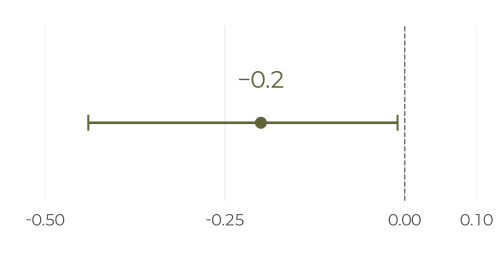
Point: estimated difference / line: 95% confidence interval
Did not meet the prespecified 0.3 mmol/L reduction target
Read Dwibedi · 2025 →View values and units
| Group | Estimate | 95% confidence interval |
|---|---|---|
| Difference versus placebo | -0.2 | -0.44 ~ -0.01 |
Study Population and Conditions
Prediabetes · randomized, placebo-controlled
- Randomized
- 89 participants
- Final analysis
- 74 participants
Extract group 35 / placebo group 39 · 12 weeks
Sulforaphane 150 μmol/day · extract study
Read Dwibedi · 2025 →Blood glucose and metabolism · research results at a glance
5 studies
Key human studies · glucose and insulin resistance
| Study and participants | Intake and observation | Findings and context |
|---|---|---|
| Dwibedi · 2025 89 adults with prediabetes assigned |
SFN 150μmol/day · 12 weeks extract 35 / placebo 39 participants | Fasting glucose 0.2 mmol/L lower than placeboFinding: Fasting glucose was 0.2 mmol/L lower than placebo. The 95% confidence interval was −0.44 to −0.01 mmol/L. Context: The prespecified 0.3 mmol/L target was not reached. Differences in HbA1c and BMI were also not significant. |
| Axelsson · 2017 Adults with type 2 diabetes |
Concentrated broccoli sprout extract placebo comparison · subgroup assessment | Blood glucose change observed in a specific patient subgroupFinding: Fasting glucose and HbA1c were lower in the subgroup with obesity and poor glucose control. Context: A result from this subgroup. Hepatic glucose production was studied in separate cell and animal research. |
| Bahadoran · 2012 81 assigned / 63 analyzed |
Sprout powder 5 or 10g/day 4 weeks · placebo controlled | Lower insulin and HOMA-IR in the 10 g/day groupFinding: Insulin and the insulin resistance measure HOMA-IR decreased in the 10 g/day group (between group effect p = 0.05). Context: A four week trial in people with type 2 diabetes comparing short term insulin resistance markers. |
Related human studies · metabolic markers measured alongside
| Study and participants | Intake and observation | Findings and context |
|---|---|---|
| Bahadoran · 2012 81 patients with type 2 diabetes assigned |
Sprout powder 5 or 10g/day 4 weeks · placebo controlled | Finding: In the 10 g/day group, triglycerides and the oxidized LDL/LDL ratio fell, while HDL rose. Context: A blood lipid assessment using the same recruitment criteria as the insulin resistance and oxidative stress reports. |
| Bahadoran · 2011 81 assigned / 63 analyzed |
Sprout powder 5 or 10 g/day; four weeks; oxidative stress measurement | Finding: Antioxidant capacity rose, while lipid oxidative damage and oxidative stress markers fell. Context: An antioxidant assessment with the same sample size and intake conditions as a 2012 report. |
Sources
- Dwibedi, et al. Nat Microbiol. 2025;10.DOI 10.1038/s41564-025-01932-w
- Axelsson, et al. Sci Transl Med. 2017;9:eaah4477.DOI 10.1126/scitranslmed.aah4477
- Bahadoran, et al. Int J Food Sci Nutr. 2012;63.DOI 10.3109/09637486.2012.665043
- Bahadoran, et al. Diabetes Res Clin Pract. 2012;96:348-354.DOI 10.1016/j.diabres.2012.01.009
- Bahadoran, et al. Eur J Clin Nutr. 2011;65.DOI 10.1038/ejcn.2011.59