Riedl · 2009 · Clinical immunology (Orlando, Fla.)
Antioxidant defense gene responses in nasal cells
Would sprout homogenate trigger defense enzyme gene responses in human upper airway cells?
Human · short-term dose-controlled trial

Key findings
Dose and cellular response
At the highest 200g dose, mean expression of NQO1 changed by +198.81% from baseline, and HO-1 by +120.86%.
Other defense genes were also measured
Dose-related responses were examined in several phase II enzyme-related genes, including GSTM1 and GSTP1.
Sites and measures assessed
These were short-term changes in nasal cell RNA.
Cell Defense Gene · NQO1
Increase from baseline · %
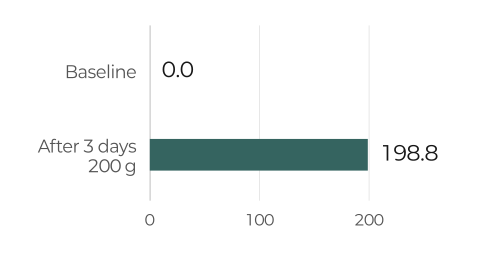
Gene expression in nasal cells
Sprout homogenate · highest dose
Read the original paper and sources ↓View values and units
| Group | Value |
|---|---|
| Baseline | 0.0 |
| After 3 days 200 g | 198.8 |
Study design
Fifty-seven healthy participants completed a dose trial. They consumed a homogenate equivalent to 25–200g of broccoli sprouts for three days. Gene expression in nasal lavage cells was analyzed, with an alfalfa control included.
- Participants
- 57 healthy participants completed
short-term dose comparison trial - Intake and observation
- Sprout homogenate equivalent to 25–200g
3 days · nasal cells measured - Measures
- RNA expression of NQO1, HO-1, and related genes
Study context
After participants consumed sprout homogenate, the expression of defense enzyme-related genes was measured in nasal cells.
Original paper and sources
Oral sulforaphane increases Phase II antioxidant enzymes in the human upper airway.
- Journal
- Clinical immunology (Orlando, Fla.) · 2009 · 130(3): 244-251
- First published
- 2008-11-22