Manesh · 2026 · Cosmetics
Kale extract, skin water loss, and wrinkles
Does consuming kale extract containing glucoraphanin change skin barrier and structural measures?
Human · open-label, single-group exploratory trial
Key findings
Skin measures before and after 56 days of intake
In an open-label kale-extract trial completed by 49 women, mean skin water loss fell from 17.8 to 16.3 g/h/m². Wrinkle depth decreased 15.1%, and dermal density increased 12.8%.
Oxidative stress measurements
Oxidative stress measures remained stable.
Transepidermal Water Loss · TEWL
Within-person mean · g/h/m²
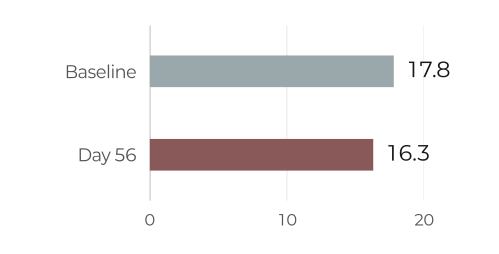
Lower values indicate less water loss · no control group
Kale extract 150 mg/day · 49 completers
Read the original paper and sources ↓View values and units
| Group | Value |
|---|---|
| Baseline | 17.8 |
| Day 56 | 16.3 |
Study design
Fifty women aged 35–55 years enrolled, and 49 completed 56 days. They consumed 150 mg/day of kale extract containing at least 17% GLR; skin water loss, elasticity, wrinkles, and dermal density were measured.
- Participants
- 49 women aged 35–55 years completed the study
Open-label, single-group intake study - Intake and observation
- Kale extract 150 mg/day
GLR ≥17% · 56 days - Measures
- TEWL · wrinkle depth · dermal density
Study context
This study compared skin measures before and after kale-extract intake without a control group. The mean individual percentage change in water loss was reported as −7.5%.
Original paper and sources
Oral Supplementation with Brassica oleracea Dry Aqueous Extract (Purebkale™) Improves Skin Barrier Function, Dermis Density, and Wrinkle Appearance: A 56-Day Open-Label Clinical Study
- Journal
- Cosmetics · 2026 · 13(1): 47
- First published
- 2026-02-20